Industrial Fire Suppression System Maintenance Schedule
Quick Answer
Industrial fire suppression systems require monthly visual checks, quarterly functional inspections, semi-annual testing of detection and actuation components, and full annual certification by a licensed technician. Specialty systems like clean agent, CO2, and water mist also need five-year and twelve-year internal inspections per NFPA 12, 17, 17A, 2001, and 750.
Why This Matters in an Industrial Setting
Industrial fire suppression systems protect what cannot be replaced quickly: production lines, control rooms, server farms, paint booths, dust collectors, and high-value equipment. When one of these systems is offline or compromised, a single ignition event can take a facility down for weeks or months. The financial loss often dwarfs any savings from delayed maintenance.
Insurance carriers are increasingly aggressive about suppression system documentation. After a loss, the first request is the maintenance log. Gaps in service history are routinely used to reduce or deny claims. A documented, scheduled maintenance program protects both physical assets and financial coverage.
The Maintenance Schedule Broken Down by Frequency
NFPA standards drive the schedule, but the specifics depend on the system type. Clean agent, CO2, dry chemical, wet chemical, water mist, and pre-action sprinkler systems each have unique requirements. The framework below applies broadly to engineered suppression systems in industrial environments.
Monthly Visual Checks
Performed by trained facility personnel:
- Confirm system pressure gauges are within operating range
- Verify the control panel shows normal status with no trouble signals
- Check that manual pull stations are accessible and unobstructed
- Confirm nozzles are unblocked and properly aimed
- Inspect cylinder mounting and physical condition
- Document any abnormalities for follow-up
Quarterly Functional Inspections
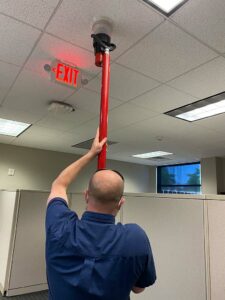
A licensed technician verifies that detection circuits, supervisory devices, and notification appliances are functioning. Trouble and supervisory signals are tested at the control panel. For systems integrated with fire alarm panels, this includes confirming the communication pathway between systems.
Semi-Annual Detection and Actuation Testing
Smoke detectors, heat detectors, linear heat cable, and flame detectors are tested to confirm response. Actuation circuits are verified without a discharging agent. Solenoid valves and release mechanisms are functionally tested using bypass methods.
Annual Full System Certification
The complete annual inspection includes weighing or pressure-checking every cylinder, verifying agent quantity against design specifications, examining piping for damage or obstruction, testing all detection devices, conducting an unloaded function test, and issuing the certification documentation that authorities having jurisdiction require.
Five-Year and Twelve-Year Internal Inspections
Specialty systems carry deeper inspection requirements. CO2 and clean agent cylinders typically require hydrostatic testing or internal examination every five or twelve years depending on the agent and cylinder design. Pre-action sprinkler systems require five-year internal pipe inspections to verify no microbial corrosion or scale buildup has compromised the line.
Common Mistakes That Take Suppression Systems Offline
 The failures that show up after a loss are almost always preventable. They look like this:
- Ignoring trouble signals on the panel. A flashing supervisory light gets reset and forgotten. The underlying fault, often a low-pressure switch or open detection circuit, stays unresolved until the system is called on and fails.
- Letting cylinders fall out of weight. Clean agent and CO2 systems lose effectiveness when cylinder weight drops outside the acceptable range. Annual weighing catches this, but only if the schedule is kept.
- Blocked or repurposed nozzles. Production changes often introduce new equipment, ductwork, or shelving that obstructs nozzle coverage. The system stays in place but no longer protects the actual hazard.
- Skipping pre-action line inspections. Microbial corrosion in dry pipe and pre-action systems is invisible until a pinhole leak appears or the pipe fails to charge during activation.
- Untrained operators silencing alarms. Personnel turnover means the staff in the building may not know what the suppression panel is telling them. Alarms get silenced rather than investigated.
- Treating fire alarm and suppression as the same system. They are integrated but separately governed. A passing fire alarm inspection does not certify the suppression system.
One manufacturing facility recently lost a paint booth and the surrounding bay because the dry chemical system had been mounted next to a vibrating compressor for eight years. The agent had compacted into the bottom of the cylinder and did not discharge during activation. The annual inspection had been deferred for budget reasons across three cycles.
In-House Program vs Outsourced Maintenance
Some industrial facilities maintain robust internal safety teams capable of running monthly and quarterly checks. Most do not. Understanding the boundary helps allocate resources correctly.
What In-House Teams Can Handle
- Monthly visual inspections with documented training
- Daily walkthroughs of high-hazard areas
- Immediate response to panel signals and abnormal conditions
- Coordination with outside vendors for required services
- Records management and audit preparation
What Must Be Outsourced to Licensed Professionals
- Quarterly and semi-annual functional testing
- Annual full system certification
- All hydrostatic and internal cylinder work
- System modifications, additions, and design changes
- Post-discharge cleanup, recharge, and recommissioning
The licensing requirement is not negotiable. Authorities having jurisdiction will not accept self-certification on engineered suppression systems. A licensed partner like Wilson Fire Equipment provides the certifications, insurance, and documentation that compliance demands.
What a Good Maintenance Contract Includes
Not all service agreements are equal. The right contract for an industrial facility includes specific elements that matter when something goes wrong.
- System inventory. Every protected area, every cylinder, every detection device documented with serial numbers and locations.
- Scheduled service calendar. Each NFPA-required interval mapped to a specific date with automated reminders.
- Documented test procedures. Each visit follows a written protocol that satisfies the relevant standard.
- Deficiency reporting. Findings are documented in writing with recommended actions and priorities.
- Emergency response provision. Defined response time for after-hours system trouble, accidental discharge, or activation events.
- Recharge and parts availability. Confirmation that the service provider stocks the agents and components your system uses.
Why Choose Wilson Fire Equipment
Experience With Engineered Industrial Systems
Wilson Fire Equipment services suppression systems across petrochemical operations, manufacturing plants, data centers, food processing facilities, paint and finishing operations, and dust collection environments. Our technicians have hands-on time with Kidde, Ansul, Fike, Janus, and other major engineered system platforms.
Reliability Through Scheduled Programs
Our maintenance contracts include automated scheduling tied to each system’s NFPA-required intervals. You never face an expired certification because a date slipped past. When discharge or trouble events occur, our emergency response team is on call.
Quality Service Backed by Current Certifications
Every technician holds active state licensing and manufacturer training on the systems they service. We maintain parts and agent inventory that lets us complete most service calls in a single visit. Explore our suppression system services for the platforms we cover.
Regional Service Coverage With Industrial Focus
We are structured to support multi-site industrial accounts with consistent service standards across locations. Whether you operate one facility or many, the documentation, response, and quality remain uniform. Reach out to start a maintenance program review.
Frequently Asked Questions
How often does an industrial fire suppression system need professional service?
Most engineered systems require professional service quarterly, semi-annually, and annually, with additional five-year and twelve-year inspections depending on system type and applicable NFPA standard.
Can my facility staff maintain the suppression system?
Facility staff can perform monthly visual checks and panel monitoring with proper training. All functional testing, certification, and internal work must be done by a licensed fire suppression professional.
What happens if we miss a scheduled inspection?
Consequences include loss of system certification, fire code violations, potential operational restrictions from authorities having jurisdiction, and serious insurance complications if a fire occurs during the lapse period.
How long does an annual suppression system inspection take?
A standard engineered system inspection takes between two and six hours depending on system size, complexity, and accessibility. Large multi-zone systems and facilities with multiple system types may require a full day or staged visits.
Does a fire alarm inspection cover the suppression system?
No. Fire alarm and suppression systems are integrated but separately governed by different NFPA standards. Each requires its own inspection, certification, and documentation regardless of how they communicate.