Choosing the Right Fire Extinguisher for Your Warehouse
Quick Answer
Most warehouses need a combination of Class A extinguishers for ordinary combustibles, Class B for flammable liquids near forklift fueling or chemical storage, and Class C for electrical hazards near charging stations and panels. Size and placement follow NFPA 10 based on hazard classification, with travel distance to an extinguisher never exceeding seventy-five feet for ordinary hazards.
Why This Matters for Warehouse Operations
Warehouses concentrate exactly the conditions that make fires dangerous: high fuel loads stacked vertically, charging batteries, propane-powered equipment, paper packaging, plastic shrink wrap, and busy traffic patterns that delay response. A small fire that would be controllable in an office becomes catastrophic in a warehouse within minutes because the fuel is everywhere.
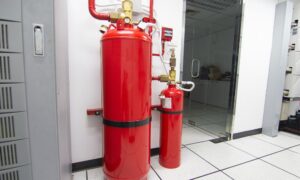
The right extinguisher near the right hazard, used by a trained employee in the first sixty seconds, is what separates a contained incident from a total inventory loss. The wrong extinguisher, a missing extinguisher, or an untrained operator turns the same event into an insurance claim and a rebuild.
Matching Extinguisher Class to Warehouse Hazards
NFPA 10 defines five hazard classes. Most warehouses encounter three or four of them, depending on operations.
Class A: Ordinary Combustibles
Get the right type of fire suppression systems in Houston for your business.Cardboard, paper, wood pallets, fabric, plastics. This is the baseline hazard in virtually every warehouse. Multipurpose ABC dry chemical or water-based extinguishers address this class effectively.
Class B: Flammable Liquids and Gases
Forklift propane, gasoline for ground equipment, paint, solvents, lubricants. Concentrate Class B protection near fueling areas, maintenance bays, and any chemical storage. Dry chemical, foam, and CO2 extinguishers handle Class B.
Class C: Energized Electrical Equipment
Battery charging stations, electrical panels, conveyor motors, server rooms inside the warehouse, and pallet rack power. CO2 and dry chemical extinguishers are non-conductive and safe for Class C. Water-based units must never be used on energized equipment.
Class D: Combustible Metals
Less common in warehouses but critical where present. Magnesium, titanium, sodium, and certain aluminum dusts require specialized Class D extinguishers. Most general-purpose units will make a Class D fire worse.
Class K: Cooking Oils
Applies to break rooms and on-site cafeterias. Wet chemical Class K extinguishers belong specifically near cooking equipment, not throughout the warehouse floor.
Size, Placement, and Travel Distance
Choosing the right class is half the equation. Size and placement are the other half, and they are equally regulated.
Extinguisher Size Ratings
Extinguishers are rated by numerical effectiveness. A 4A:80B:C rating means the unit can handle a Class A fire equivalent to four standard test fires, a Class B fire of eighty square feet, and is safe for Class C. Larger warehouses with higher fuel loads need higher ratings, typically 10A:60B:C or larger.
Travel Distance Rules
NFPA 10 sets maximum travel distance from any point in the building to the nearest extinguisher:
- Light hazard: seventy-five feet for Class A, fifty feet for Class B
- Ordinary hazard: seventy-five feet for Class A, fifty feet for Class B
- Extra hazard: seventy-five feet for Class A, thirty feet for Class B
Pallet rack aisles, dock doors, and equipment yards count as travel distance. A unit visible across the building but blocked by a forty-foot rack aisle does not satisfy the rule.
Mounting and Visibility
Extinguishers heavier than forty pounds must be mounted so the top is no more than three and a half feet from the floor. Lighter units can be up to five feet. Signage above the unit must be visible from a distance, particularly in tall warehouses where the unit itself disappears behind equipment.
Common Mistakes That Leave Warehouses Underprotected
Warehouse extinguisher gaps tend to follow predictable patterns. They show up during fire marshal inspections and, more painfully, during actual fires.
- Using only one extinguisher class throughout. A facility-wide deployment of ABC dry chemical leaves charging stations adequately covered for Class C but creates a corrosion and cleanup nightmare on electronics. CO2 is the better fit there.
- Undersized units in high-hazard areas. A five-pound extinguisher near a forklift fueling station is essentially decorative. Higher-hazard zones need 10-pound or 20-pound units with appropriate ratings.
- Placement that ignores actual traffic patterns. Extinguishers mounted next to the office door are useless when the fire is at the back of the building. Placement must follow the hazards, not the architecture.
- Blocked access during peak operations. Holiday inventory, returned freight, and seasonal staging routinely block extinguisher access. The unit is still mounted, but the path to it is gone.
- No clear identification. In a tall warehouse with vertical signage, a wall-mounted extinguisher with no overhead indicator might be invisible from twenty feet away.
- Skipped employee training. An untrained employee will not use an extinguisher correctly, or at all. OSHA requires training for any employee expected to use portable fire extinguishers.
A regional logistics facility recently took a complete loss in a single bay because the only Class C extinguisher near the battery charging station had been moved during a layout change and never remounted. By the time staff retrieved a unit from across the warehouse, the lithium-ion battery fire had spread to surrounding pallets.
Dry Chemical vs Clean Agent vs Water Mist for Warehouse Use
Portable extinguisher technology has evolved. Knowing the trade-offs helps match the right product to the right hazard.
ABC Dry Chemical
- Lowest cost per pound of agent
- Effective on Class A, B, and C fires
- Significant cleanup required after discharge
- Corrosive to electronics and bare metal surfaces
- Workhorse choice for general warehouse floors
CO2
- No residue, ideal for electrical and electronics areas
- Limited Class A effectiveness
- Heavy cylinders requiring stronger mounting
- Best in charging stations, IT rooms, and equipment bays
Clean Agent (Halotron, FE-36)
- Non-corrosive, no residue
- Effective on Class A, B, and C
- Higher cost per unit
- Ideal for high-value inventory, automation equipment, and sensitive electronics
Water Mist and Foam
- Effective for Class A and certain Class B applications
- Less effective on energized equipment unless specifically rated
- Useful in specialized areas like archival storage or food-grade environments
The best warehouse program rarely uses one product everywhere. A hazard survey conducted by a professional like Wilson Fire Equipment matches the right unit to each area and documents the rationale for insurance and code compliance.
Building the Right Extinguisher Plan for Your Warehouse
Effective protection starts with a hazard map and ends with documented training.
- Conduct a hazard survey. Walk the facility area by area and identify the fuel types, ignition sources, and traffic patterns.
- Classify zones. Assign each area a hazard class and match it to the appropriate extinguisher type, size, and rating.
- Place extinguishers per NFPA 10. Verify travel distance, mounting height, and visibility for every location.
- Document the layout. A facility map showing each extinguisher position is required for compliance and useful during emergencies.
- Train employees. OSHA requires hands-on or documented training for anyone expected to use an extinguisher.
- Schedule inspections. Monthly visual checks and annual professional service, with all documentation retained for audits.
Why Choose Wilson Fire Equipment
Experience With Warehouse and Distribution Environments
Wilson Fire Equipment has equipped and serviced warehouses ranging from small regional distribution centers to large multi-tenant logistics facilities. We understand the unique hazards: lithium-ion battery rooms, propane forklift fueling, automated storage and retrieval systems, and high-piled storage occupancies.
Reliability From Initial Hazard Survey Through Annual Service
Our team conducts the survey, recommends the right inventory, installs the units, and returns for required inspections. The same provider handles the program end to end, so nothing falls through the cracks during layout changes or operational shifts.
Quality Equipment From Trusted Manufacturers
We supply Amerex, Ansul, Buckeye, and other UL-listed extinguishers across every class. From standard dry chemical to clean agent units for sensitive areas, the right product is available. Explore our portable extinguisher offerings for the full range.
Service Coverage That Scales With Your Operation
Whether you run one warehouse or a regional network, we provide consistent service standards, route-based scheduling, and unified documentation across sites. Contact us to schedule a hazard survey for your facility.
Frequently Asked Questions
How many fire extinguishers does my warehouse need?
The number depends on the building’s hazard classification, square footage, and layout. NFPA 10 requires that no point in the building exceed seventy-five feet of travel distance to an extinguisher for Class A coverage. A professional hazard survey produces the exact count.
Can I use one type of extinguisher throughout my warehouse?
It is technically possible with ABC dry chemical, but rarely optimal. Charging stations, electronics areas, and high-value inventory zones benefit from CO2 or clean agent units that leave no residue. A mixed deployment matches each hazard correctly.
Do my employees need training on fire extinguisher use?
Yes. OSHA requires hands-on or documented training for any employee expected to use a portable fire extinguisher. Untrained staff are not expected to fight fires and should evacuate while the fire department is called.
What size extinguisher should I install near forklift charging stations?
Charging stations with lithium-ion batteries require a minimum 10-pound ABC dry chemical or appropriately rated clean agent unit. The unit must be mounted within a short travel distance and clearly marked with overhead signage.
Are water-based extinguishers safe to use in warehouses?
Water-based units are effective on Class A combustibles like cardboard and wood, but they cannot be used near energized electrical equipment, flammable liquids, or combustible metals. They are typically deployed alongside dry chemical or CO2 units rather than as a primary protection.